PERIOD HISTORY
The Taunton Garrison portrays three main times periods described below.
The Spanish Armada campaign (1588)
“Seek peace…but prepare for war!”
In the late 16th century, England was viewed as, ‘an upstart Protestant nation,’ which was a constant thorn in the side of Phillip II of Spain.
Phillip II had offered Queen Elizabeth a hand in marriage in 1559 but had been turned down. Phillip then hoped that Mary Queen of Scots may succeed Elizabeth which would give him a northern catholic ally with which to aid his fight against the Dutch and the French.
However, Elizabeth’s spymaster – Francis Walsingham implicated Mary in an assassination plot (Babbington) and had her executed.
English privateers had been raiding Spanish colonies and attacking the Spanish treasure fleets for twenty years. Deliberate acts of aggression which Elizabeth did nothing to condemn them. In 1585 she pledged her support to the Dutch in their war with the Spanish which led to more hostility between the two powers.
For much of the period Phillip did not act against England, as he saw France as the more dangerous foe. He did however encourage rebellions in Ireland and offer support to numerous assassination attempts on Elizabeth. He eventually decided on an assault on England after receiving papal support for a crusade against the heretic queen.
Francis Drake had made a pre-emptive strike in Cadiz in 1587. This, ‘singeing the king of Spain’s beard,’ delayed the armada by a year. Thus giving England a little time to prepare its defences.
In 1587 Lord Howard of Effingham (one of Elizabeth’s cousins on her mother’s side) was appointed Lieutenant General and Commander in Chief of the navy. He was an able (but not the best) commander who was given support by the nobility. He was also the perfect individual to keep some egos in check such as Drakes.
1588
19th July – Armada of 100+ ships spotted off the Lizard. Speedy ships were sent to London to alert the authorities. The navy at Plymouth sallied out and offered battle but only managed in doing slight damage as the armada progressed up the channel.
27th July – armada anchored off Calais. English send in 8 fireships on the 28th July. No Spanish ships were sunk, but they were forced to cut their cables and disperse into the North Sea.
This led to the Battle of Gravelines which forced the Spanish to return home via the north of Scotland. Due to poor navigation and extremely rough weather, several ships were destroyed on the coasts of Scotland and Ireland.
The opposing forces
The Spanish army at the time was the most powerful, best organised, best equipped in Europe. The Spanish army had recently crushed the Dutch revolt under the feared and much respected Duke of Parma.
England’s land defences were poor; troops were hastily recruited with little or no training. No modern fortifications had been built, whilst Henry VIII’s 50 year old castles were now vulnerable to more modern cannons.
It has been well documented by historical sources that if the Spanish had landed in Deal (Sandwich area) they would have reached London within a week.
It is to be remembered that at its apogee, Phillip’s empire was bigger than the Romans. It included: Spain, ¼ of Western Europe’s population, Spanish Netherlands, Mexico, Peru, Philippines and several other islands.
They also recruited vast numbers of solid soldiers from Northern Italy.
Phillip did not want to rule England himself, he did want however for England to return to Catholicism, the restoration of stolen church lands and the restoration of the monasteries. His plans were given more clout when the pope excommunicated Elizabeth.
To face the overpowering might of the Spanish empire, England was, ‘small, poor, with very few friends and many enemies.’
The Spanish Army
The army was originally formed into a, ‘Colunella,’ led by a colonel which could consist of up to 6,000 men. This formation transformed the medieval style of pike and halberd into a more modern army consisting of pikemen and arquebusiers.
This formation soon transformed into the more formidable, ‘tercio.’ This was formed of three brigades. It was made up of: a third pikemen, a third swordsmen (short sword and buckler) and a third firearms.
These soldiers were aggressive, disciplined and self confident. Often set-up in a hollow square, the tercio combined: the staying power of pikemen, with the range power of firearms with the combat assault ability of swordsmen.
Trained Bands of England
This part-time militia was split into three: trained bands, untrained bands and pioneers.
Trained Bands were chosen volunteers from the community. They trained either two days a month or one week every three months. As the local parish were paying, they tended to keep it to a few days a year.
Average pay was one shilling a day.
Equipment was normally given out just for training but it was found more cost effective to give the equipment out on a permanent basis.
Roughly 10% of the eligible population were in the trained bands.
Untrained Bands made up the bulk of the resident population. They received no regular training and were only called upon in a crisis. They were trained by the trained bands and used to fill the ranks. If they left the county they were then paid by the state.
Pioneers were the last group and were from the lowest social orders: wastrels, vagrants, vagabonds and criminals who were used as cannon / arrow fodder.
They received no training and few weapons. If troops were needed in Ireland, they would more often than not be pioneers.
Trained Band units varied in size in 1588, 1,000 men regiments were known but not recommended. The Lord Lieutenant would commission the local sheriff and local justices to choose: captains, sergeants and corporals. Justices would obviously encourage pioneers to be chosen.
Tactics
Very little is known except archers would be on the flank to soften up the enemy which would precede an infantry attack. Archers and firearms would then deploy to the flanks. Later in the 16th century the English started mirroring Spanish tactics.
Uniforms
Northamptonshires were issued green coats (archers and firearms) and blue coats (polearm troops). Summer issue for troops to go into the Low Countries (1575). Canvas doublet lined with white linen, breeches, stockings and a hat.
Weapons
Prior to the Armada there is little evidence of muskets being popular. It was more bows and calivers.
In 1575, this was the breakdown of an average unit:
30 – 60% range troops
15% bows, 20% calivers and 20% muskets
10% bills, 5% halberds and 30& pikes
Calivers had a smaller bore therefore less accuracy and less penetrating power. The early muskets needed a rest which reduced the firing rate per minute from 3 to 1.
Bows were still used after the turn of the century even though it was officially ordered to cease in 1593. An archer could reach out to 300 yards at a rate of 6 arrows a minute. Records show a 3 foot square target could be easily hit at 100 yards.
Armour
This could include: a leather padded / mail jerkin, a helmet, vambraces (forearm armour), a good sword, a short dagger, a bow, a sheaf of arrows and 3 bow strings.
The ranking system could often be: Lieutenant General, Sergeant Major General, Colonel Capitaine, Lieutenant, Sergeant Major, Ensign, Sergeant and Corporal.
Earlier titles often included: Ancient and a Wiffler. Corporal of the Field /Corporal of the Camp were acting titles for Lieutenants.
Halberds were carried by sergeants (also by a contingent of the company designated as a colour guard).
Other Weapons
The threat of the Spanish brought medieval weapons back into use: rapier, broadsword, cutting sword, battle axe, mace, dagger, basilard, arbalest, bill, bow, great swords of 72 inches, crossbow, halberd, pike, poleaxe and spear.
****
The English Civil War (1642 - 1651)
The English Civil War was essentially an argument between King Charles I and parliament over the issue of the divine right of kings. Should the king be able to rule without recourse to parliament? There were other simmering issues that pushed the country into war. These were varied and complex, they included: religion, foreign wars, taxes and the unpopularity of some of the king's advisors. The war split communities and families apart. Father against son and brother against brother. Pillaging was rife and the sacking of towns after a siege was merciless. The king was finally executed in 1649. This however did not stop the wars nor the killing. The king's son, also called Charles landed in Scotland and marched south to reclaim his father's throne. Only to be defeated at the battle of Worcester. The country remained a republic under Oliver Cromwell, then his son Richard Cromwell until 1660 when Charles II was invited to return as king.
The course of the war
The king raised his standard in August 1642 at Nottingham declaring war on parliament. Towns and cities were quickly garrisoned either for the king of for parliament. Hull was closed to the king as one of the first actions of the war, denying Charles a port and a large armoury and magazine. Early fumblings and missed opportunities abounded leading to the King being repelled from London by the Trained Bands. He was never to return to London until he was tried for his life.
Big pitched battles were rare as most campaigning concentrated around besieging towns, cities and ports. Big battles did take place and were crucial in the outcome of the war. Names of these battles still resound down the ages such as: Edgehill, Marston Moor, Lansdown Hill, Cropedy Bridge, Naseby, Worcester etc
As the war dragged on, Charles' territory, arms and manpower dwindled, especially after the Scots had joined the parliamentary side and the New Model Army had formed providing parliament with a: seasoned, paid and veteran force.
Charles surrendered to the Scots in 1646 and is soon handed over parliament. During the king's trial he continues to refuse to acknowledge the legitimacy of the court and is condemned to death. Charles was beheaded on 30th January 1649.
After the king was dead and the monarchy abolished, Cromwell led an army to Scotland to defeat Charles's son at Dunbar and finally at Worcester to end the horror and bloodshed of the English Civil Wars.
The opposing forces
To start with, the opposing armies were mainly made up of volunteers, amateur soldiers with the odd experienced soldier who had fought on the continent. Arms were in short supply, uniforms were pretty much non-existent and weapons were definitely not standardised - making supply a logistical nightmare. Baggage trains were few and far between. Added to the poor state of the roads, campaigning was restricted to the spring and summer months.
At the outbreak of the war, the navy rallied to parliament ensuring arms, supplies, men and money was difficult for the king to get from the continent.This also allowed parliament to trade with other countries, receive supplies and undergo amphibious operations.
To begin with, men had no uniform (maybe a coat supplied by a colonel), but shoes, breeches, stockings, hats etc would belong to the men themselves. This made things very awkward in the midst of the battle not knowing who was on which side. Even when uniforms were supplied, there would be units fighting an enemy with the same colour coats as themselves.
The armies of the civil wars could be roughly divided into the following categories: musket, pike, cavalry and artillery.
Musket
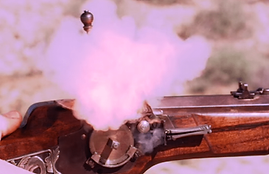
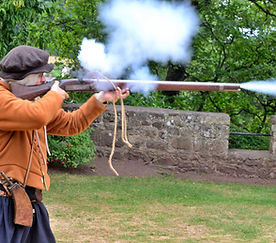
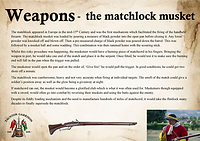
At the start of the war, muskets were heavy, unstandardised and rare. Many muskets were so heavy, they required a rest to support them when firing. As the war progressed, muskets became lighter, standardised and very common in battle. The main type of musket was the matchlock which was fired by a piece of burning cord being placed into the pan. A good musketeer would be able to get at least 2 shots off per minute. The main drawbacks of the weapon were: had to keep the match lit, could be easily seen at night, not suitable for guarding powder trains, takes time to resit the match every time you fire and pretty much useless in wet weather.
Another type of firearm was the flintlock. Much rarer than the matchlock and more expensive to produce. This weapon worked by a piece of flint scraping a piece of steel to create sparks which ignited the powder in the pan. Very useful for dragoons, sentries and when guarding powder stores. The flintlock was not necessarily more accurate than the matchlock as many flintlocks were just matchlocks with a new lock fitted. A great advantage of the flintlock was the pan was kept covered until the moment of firing. Ensuring the powder did not get wet or blown away.
An even rarer ignition system was the wheel-lock. This was mainly used in pistols and therefore favoured by officers and cavalry. This lock worked by a wheel of steel being turned by a key until locked in place. This wheel had teeth cut into it. A piece of iron pyrites was placed on top of the wheel. When the trigger was pulled, the wheel span around creating sparks and igniting the charge. This weapon was slow to load, prone to breaking and if the spanner was lost, the weapon was useless. It did however, mean the weapon could be loaded and ready to fire at a moment's notice.
Pike
Approximately one third of the infantry would be armed with the pike. The pike was between 16 and 18 foot long, tipped with a metal spike and was an anti-infantry and anti-cavalry weapon. The pike was seen as an elite weapon, wielded by strong men whilst musketeering was seen as a dirty and grubby affair.
At the beginning of the war, pikemen would be heavily armoured: wearing helmets, back and breastplates and tassets to protect the thighs. As the war progressed, more and more armour was discarded as it proved ineffectual against musket shot and was hard work marching with it.
The pikemen would work in pike blocks, dense squares of men who would be bristling with metal spikes. There job was threefold: to fight other pike blocks (push of pike) where the object was to physically push the enemy back, to protect reloading musketeers and finally to steer cavalry away.
The pikeman were also equipped with a tuck, a short sword to use in close combat. These were deliberately short as the pikeman had to draw it one handed as he had to handle his pike at the same time.
Artillery
At the start of the war, artillery was very limited, of various calibres, ammunition was in short supply and the number of trained gunners was low indeed. Artillery could be divided into three main categories: anti-personnel, anti-fortifications and mortars.
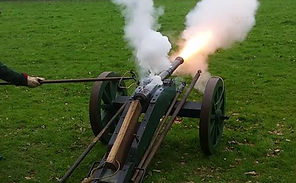
Cannons ranged from a robinet which could fire a ball weighing 3/4lb to the vast cannon royal which fired a ball weighing 63lbs. A cannon royal would need a team of 16 horses to pull it and a colossal 40lbs of gunpowder to fire it!
There were three main types of ammunition used: solid roundshot which could punch through whole columns of men or walls. Canister was a metal or wooden tube filled with scraps of metal, musket balls, nails etc and was designed to burst on the ground in front of attacking men and horses. And finally, grapeshot was a wooden 'tree,' made up of circles of wood, interlaced with musket balls which when fired would spread through the air causing a shotgun like effect.
Cavalry
The cavalry played a very important role in the civil wars. It was used to: screen an army's flank and front when advancing, make raids into enemy territory, attack enemy horse in battle and to chase a defeated enemy after the battle was won.
Cavalry were armed and armoured very differently as the war progressed. To start the war, there were units of cuirassier, fully armoured knights who rode into battle with sword and pistol. However, like the pikeman, armour rapidly became redundant and was replaced by buffcoats, breastplates, helmets or even soft hats.
Dragoons were also a common sight. Horsemen who rode into battle on smaller horses, dismounted and then fought on foot as regular infantrymen. These men would have been issued with flintlock carbines.
The Monmouth Rebellion (1685)
The Monmouth Rebellion of 1685 resulted from the fact that King Charles II, son of Charles I (of English Civil War fame), died without a legitimate heir. The throne passed to his brother who became King James II. Monmouth was the eldest illegitimate son of Charles II and was persuaded by political factions that the people of England would prefer him to be King rather than James. James was a Catholic and Monmouth a Protestant. The English feared a return to the oppressive Catholic regime of 'Bloody' Queen Mary. Monmouth tried his luck by invading the country at Lyme Regis in June 1685 with only 82 followers. Monmouth had some initial success, and by the time he reached Taunton had amassed around 6,000 men. The men were not, as usually depicted, 'rough ploughmen' but were largely tradesmen or cloth workers.
They were, however, mostly untrained raw recruits (Monmouth was hoping the regular army would defect to him). After a setback at Bristol, Monmouth ended up retreating to Bridgwater and eventually trying a desperate night attack across the open moor to catch the Royal army asleep in their tents. It was a close thing but the element of surprise was lost and Monmouth was defeated. The resultant retribution became the well known 'Bloody Assizes' of Judge Jefferies.
Weapons - click on the images for larger version
Living History
Taunton Garrison is capable of putting on a varied show for the whole day. As well as military demonstrations and skirmishes we can populate appropriate rooms in a castle, or similar, or set up a Living History campsite. In this mode we can perform cameos that enact actual historical events, such as the Duke of Monmouth arriving at Taunton Castle, or generic roles such as the life of a Coffee House, for example. We also have people that demonstrate various skills of the period, such as: barber surgeon, drumming, coin making, cooking, cloth dying, blacksmithing and much more...
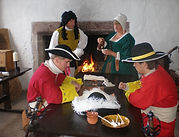
Above, we see a typical Coffee house of the late C17th. Coffee houses were very popular from 1670 on into the C18th. These establishments served not only coffee, but often tea (green) and chocolate. The fee was usually a penny, for this you got a cup of coffee and a clay pipe of tobacco. It was the custom to drop the penny into a cup or bowl, to show you could pay. This custom gave rise to the modern term used for leaving a gratuites in a cafe - tips. Tips, in the C17th meant - 'To Insure Prompt Service.' Coffee houses were places where men would go to talk on various matters, they became known as 'Penny Universities' because of all the 'experts' to be found in them. Some began to attract customers who had similar interests, in London a coffee house where sea captains and maritime insurers met was Lloyd's Coffee House. This became Lloyd's of London. Other houses became just as famous e.g Jonathan's Coffee House in Exchange Alley in London, became the London Stock Exchange.
Above are pictures from a day we spent filming with Michael Portillo and the BBC for his Railway Journey series. We spent some very enjoyable hours filming a trial scene where Michael Portillo was playing the rebel John Hucker. He was found guilty in every take!
Our Living History brings our events alive (it's not just pike and muskets!) Roles in Living History vary from cooking in the camp to displaying wares such as pottery from the period. We have ladies who dye wool, repair garments and a lot of times - get stuck into the fighting!